
I recently partnered with Pure Frequencies, and their tuning forks brought up a question I couldn’t resist exploring: How can you feel a sound as well as hear it?
If you’ve ever held a weighted tuning fork against your body, you know the sensation is hard to describe until you try it. The hum starts at the point of contact, but you may feel it along a muscle or near a joint. It can seem to travel farther than you expect.
That made me curious about what is actually happening. Can the vibration reach bone? Is one frequency more helpful than another? And what can we honestly say about the health benefits?
Let’s take a closer look.
What Is Tuning Fork Therapy?
A tuning fork is a U-shaped metal instrument. Strike it with the appropriate activator, and its two prongs vibrate at a set frequency. A 128 Hz fork, for example, vibrates 128 times each second.
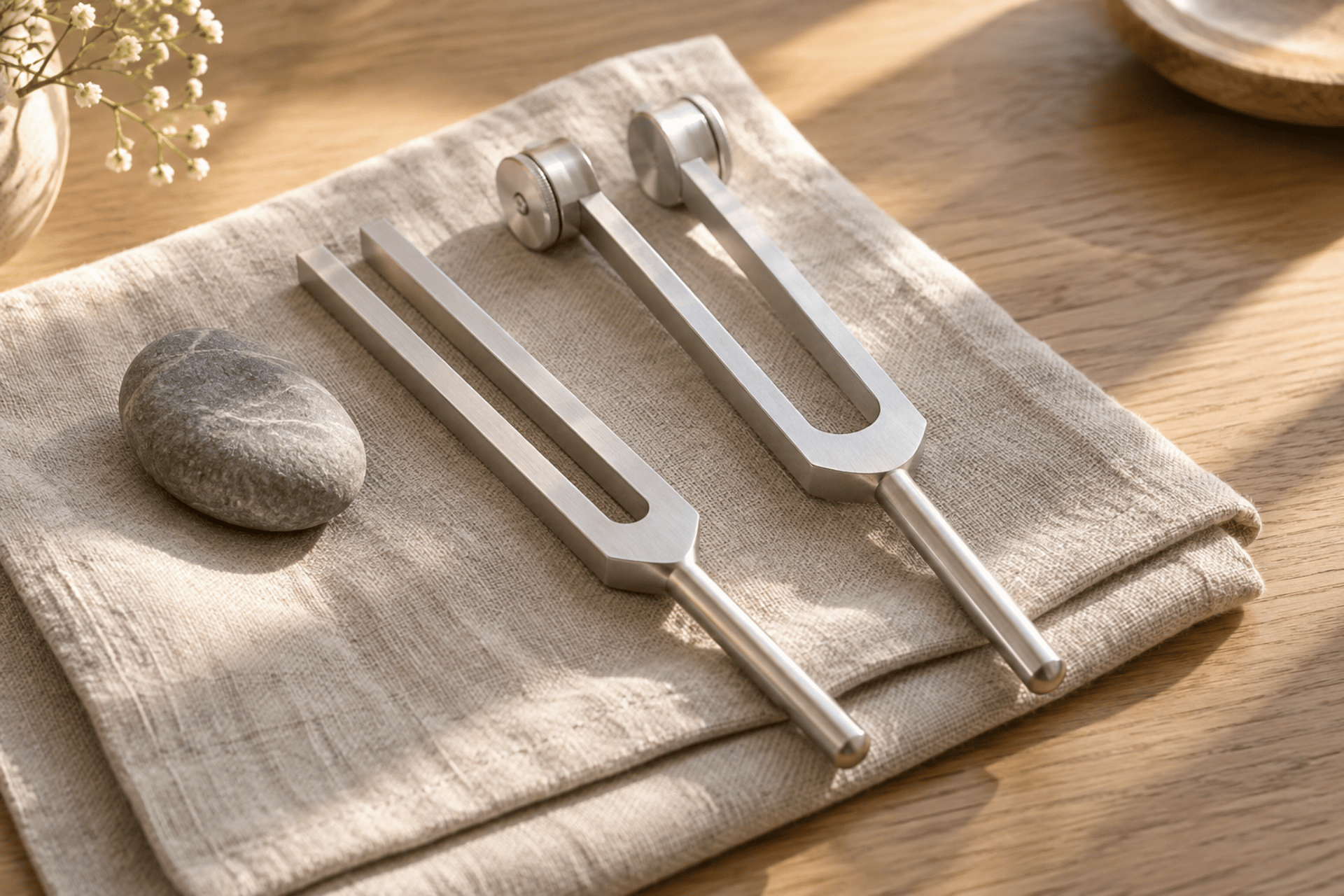
Some forks are meant primarily to be heard. You hold them near the body and listen as the tone fades. Others, especially weighted forks, can be placed gently against the body so you can feel the vibration. People use them during meditation, before bed, or whenever they want a few minutes to pause and breathe.
You may have encountered a tuning fork in a doctor’s office. Doctors use them to check hearing, while a 128 Hz fork can help assess whether you can feel vibration, often during a neurological or foot exam.[1][2]
How Does a Tuning Fork Work?
When you activate a tuning fork, its prongs move back and forth. They move the air around them, creating the tone you hear. The vibration also travels through the fork’s stem. Hold that stem against your body, and you may feel it as a buzz or gentle pulse. Both the sound and the sensation gradually fade.
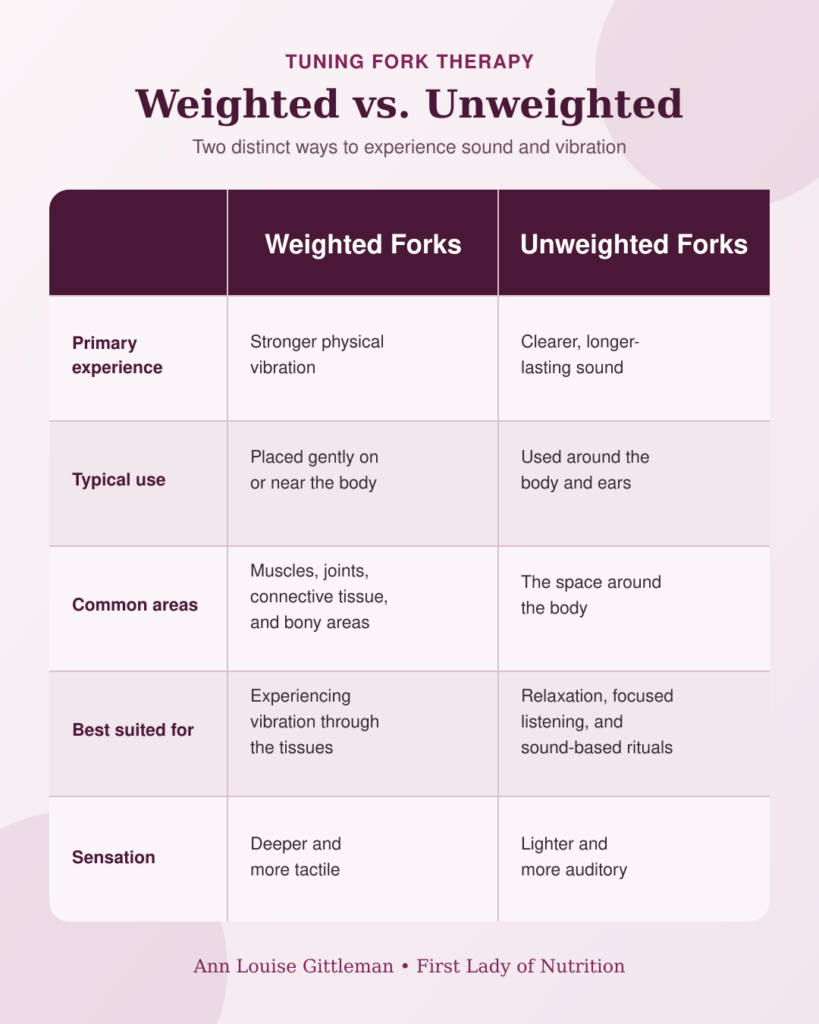
The weights attached to some forks change the way they vibrate. A weighted fork gives you a stronger sensation through the stem. An unweighted fork generally produces a clearer, longer-lasting tone. That’s the practical difference to keep in mind when choosing one.
Why Can You Feel the Vibration Near Bone?
For those of you who know me, I’m very interested in bone health. I’ve written recently about a different use of vibration in my article on Juvent vibration plates and bone health. I even interviewed the company’s CEO, Rush Simonson.
A tuning fork and a vibration platform work differently, but both have made me curious about how we experience vibration.
Bone conducts vibration. In a hearing exam, a doctor may place a vibrating fork against the skull. Sound can then reach the inner ear through the bones of the head, a process called bone conduction.[2][3]
A weighted fork placed elsewhere on the body can send vibration through the tissues around the contact point and possibly along nearby bone. That helps explain why the sensation may seem to extend beyond the spot where the stem rests.
You may also have heard that bones respond to mechanical signals. They do. Walking and resistance exercise place loads on bone, and bone cells respond to those loads through a process called mechanotransduction.[4][5]
> Don’t forget this! Bones also need nutrients. Check out my article, “What If You’re Not Sick, but Undernourished? Your Bones May Be Starving.”
Weighted or Unweighted: Which Fork Should You Choose?
If you’re drawn to the feeling of vibration, try a weighted fork. Place it gently against your body and notice how the sensation changes as the fork slows. If it’s the sound you love, an unweighted fork lets you linger with the tone. You might reach for one at different times, or enjoy using them together.
With a weighted fork, the stem is placed gently on a comfortable area of the body. With an unweighted fork, the sound is the main attraction; it’s usually held near the body or at a comfortable distance from the ears. Follow the instructions for your particular fork, since designs and recommended uses vary.
What Does the Research Say About Specific Frequencies?
Each tuning fork is tuned to a frequency measured in hertz, or vibrations per second. A 128 Hz fork vibrates 128 times a second; a 256 Hz fork vibrates twice as often and produces a higher pitch.
The difference is something you can feel as well as hear. Lower-frequency forks, such as 128 Hz, produce a more noticeable physical vibration when placed against the body. In clinical exams, a 128 Hz fork is used to check whether someone can sense vibration. A 512 Hz fork is commonly used for hearing tests because it produces less tactile vibration.
What’s the Best Way to Try a Tuning Fork at Home?
- Find a comfortable place to sit and start with the directions that came with your fork.
- Hold the fork by its stem, leaving the prongs free to vibrate.
- Activate it with the recommended rubber striker or activator. Avoid striking it against a hard surface.
- If it’s a weighted fork, rest the base of the stem gently on a comfortable area, such as a tense muscle. Use light pressure.
- If it’s unweighted, hold it at a comfortable distance from your ears and listen as the tone fades.
- Breathe slowly. A minute or two is plenty for a first try.
Stop if you feel pain, dizziness, a headache, or any other discomfort. Don’t place a vibrating fork on an open wound, an acute injury, or a suspected fracture. Keep it away from your eyes, and don’t hold a loud tone close to your ear. If you have a medical implant, significant sound sensitivity, or a condition that makes vibration a concern, check with your healthcare practitioner before using a weighted fork on your body.
Why I Partnered with Pure Frequencies
Pure Frequencies offers both weighted and unweighted forks, along with guidance for using them at home. I was especially interested in the weighted forks because you can feel their vibration as well as hear it. That sensory experience is what prompted the questions behind this article.
>> If you’d like to explore their selection, you can visit Pure Frequencies through my personal link and save 10%.
Frequently Asked Questions About Tuning Fork Therapy
What is tuning fork therapy?
Tuning fork therapy is a sound- and vibration-based wellness practice. An activated fork produces a specific tone and frequency. Depending on the design, it may be held near the body for listening or placed gently against the body so the vibration can be felt.
Do tuning forks really work?
Many people find tuning forks calming and enjoyable. Broader research on sound and vibration suggests possible benefits for relaxation, stress, and emotional well-being. Studies specifically testing handheld tuning forks remain limited, so stronger health claims have not been established.
Can tuning fork vibrations reach the bones?
Mechanical vibration from a weighted fork can travel through tissues around the contact point and may be conducted along nearby bone. This can create a deep resonance that you feel beyond the surface.
What is the difference between weighted and unweighted tuning forks?
Weighted forks create a stronger tactile vibration and are commonly placed on or near the body. Unweighted forks produce a clearer, longer-lasting tone and are generally held near the body or ears. Some people combine both types in one relaxation ritual.
What are tuning forks for healing commonly used for?
People commonly use them during relaxation, meditation, focused breathing, bedtime routines, and bodywork. Weighted forks may also be used around tense muscles or joints for a soothing sensory experience. They should complement appropriate medical care rather than replace it.
Is tuning fork therapy safe?
It is generally a gentle practice when the forks are used as directed. Avoid open wounds, acute injuries, suspected fractures, the eyes, and painfully sensitive areas. Keep sound at a comfortable distance from the ears and stop if you feel unwell.
Can you use tuning forks on yourself?
Yes. Many sets are intended for home use and include guided instructions. Begin with a short session, use gentle contact, and learn how your body responds before increasing the length or frequency of use.
How often can you use tuning forks?
There is no clinically established schedule. Some people enjoy a short daily ritual, while others use them only when they want help settling down. Follow the manufacturer’s guidance and keep the experience comfortable.
Sources and Further Reading
Eraniyan K, et al. History and Evolution of the Tuning Fork. Journal of Audiology and Otology. 2024.
Kong EL, Fowler JB. Rinne Test. StatPearls. National Library of Medicine.
Stenfelt S, Goode RL. Bone-conducted sound: physiological and clinical aspects. Otology and Neurotology. 2005.
Duncan RL, Turner CH. Mechanotransduction and the functional response of bone to mechanical strain. Calcified Tissue International. 1995.
Hughes JM, et al. Mechanotransduction in human bone: cellular physiology that underpins bone changes with exercise. Sports Medicine. 2008.
National Center for Complementary and Integrative Health. Music and Health: What You Need To Know.
Kantorová L, et al. Exploring vibroacoustic therapy in adults experiencing pain: a scoping review. BMJ Open. 2022.
Effects of Vibroacoustic Stimulation on Psychological, Physiological, and Cognitive Stress. 2024.
These statements have not been evaluated by the Food and Drug Administration. These products are not intended to diagnose, treat, cure, or prevent any disease.