

Signs Your Kidneys Need Help—Now
I am seeing a silent epidemic unfold before our very eyes that nobody is talking about.
KIDNEY FAILURE
I have at least 10 clients who are facing dialysis –– something I have never seen before in young people.
Your Kidneys Are Quietly Running the Show
In Traditional Chinese Medicine, the kidneys reign as King while even the heart is subservient to the kidneys –– the root of all health.
In Chinese medicine the kidneys are the root. They hold your deepest energy reserves, support your bones, and help steady the part of you that keeps going when things get hard. When that root weakens, energy drops, hormones shift, blood pressure rises, and you begin to experience many of the symptoms mentioned below.
Western labs catch the same decline in different ways: a falling GFR (eGFR), rising creatinine, higher BUN, or protein in the urine. Any one of those changes is a signal. So is blood in the urine.
Early Signs of Kidney Problems
Your kidneys do not send loud warnings. They keep working until the damage is already underway. You may already feel the strain even if your labs still look acceptable.
These are early signs of kidney problems:
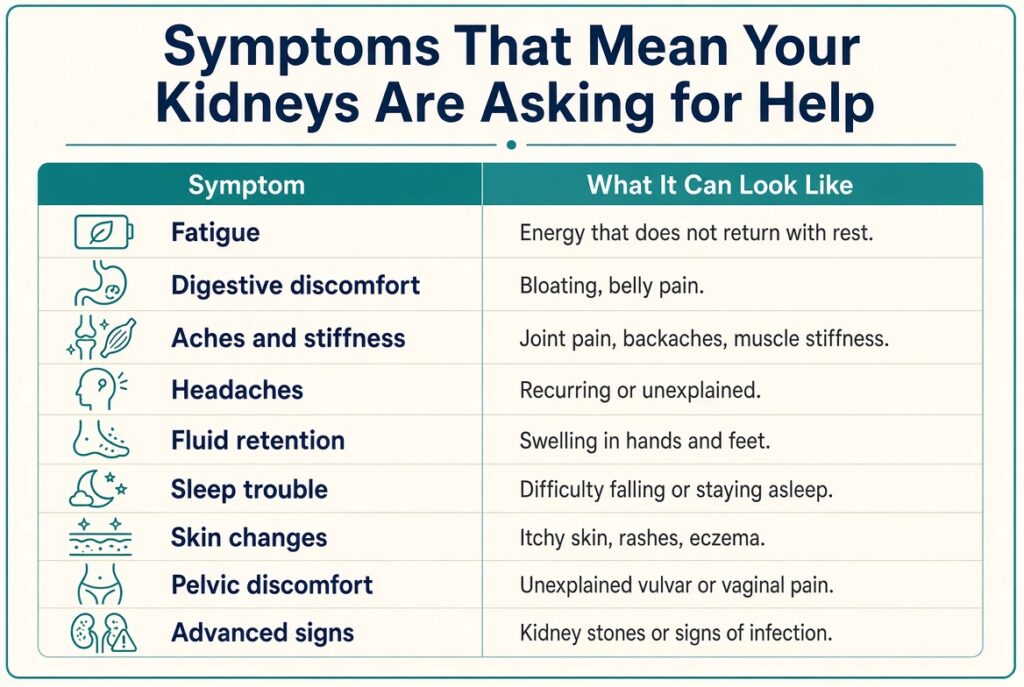
If several of these sound familiar, the next step is to look at the full set of kidney function numbers on your lab report—not just GFR (eGFR), but creatinine and BUN as well.
(If you want more details on supporting kidney health, see my earlier article on the signs you may need a kidney cleanse.)
What Your Kidney Numbers Are Telling You
On the lab report from your kidney function test, you’ll usually see eGFR, an estimate of how well your kidneys filter waste from your blood. I want you to know yours and ask how it compares with previous results.
Kidney function generally declines with age but that doesn’t mean this is normal. For perspective, here are average filtration values published by the National Institutes of Health:
Normal GFR (eGFR) by Age
20–29 | 116
30–39 | 107
40–49 | 99
50–59 | 93
60–69 | 85
70+ | 75
A falling number deserves attention. So does a low GFR (below 60) that persists for at least three months. Your practitioner should interpret it alongside your history and a urine test for albumin, a protein that can leak into urine when kidneys are damaged.
Please remember: blood in your urine always needs medical evaluation, even once.
Two Other Numbers to Understand: Creatinine and BUN
• Creatinine: A waste product from normal muscle activity that your kidneys remove. It’s commonly used to calculate eGFR. Typical adult blood creatinine levels range from 0.5–0.95 mg/dL for women and 0.7–1.3 mg/dL for men.
• BUN: Blood urea nitrogen, a waste product formed when your body breaks down protein. A high result can reflect kidney problems, dehydration or a high-protein diet*, among other causes. A typical adult BUN level ranges from 6–20 mg/dL.
The High Protein Connection
*Which brings me to something I’ve been wondering: With protein shakes, bars and high-protein diets everywhere, are some people eating more protein than their kidneys can comfortably handle?
Protein is essential, especially for maintaining muscle as we age. But more isn’t automatically better. People with chronic kidney disease may need to adjust their intake with professional guidance.
The COVID Connection
What about COVID? Studies have linked infection, particularly severe illness, with later kidney decline.
- A 2024 cohort study in JAMA Network Open of more than 134,000 people with COVID-19 and nearly 36,000 with pneumonia found accelerated annual eGFR decline after COVID-19 (about 3.4%) compared with pneumonia (about 2.3%). The decline was steeper among those hospitalized for COVID-19 (about 5.4%).
- Research published in the Journal of the American Society of Nephrology showed that 30-day COVID-19 survivors had higher risks of eGFR decline, end-stage kidney disease, and major adverse kidney events. Risks rose with the severity of the acute illness (non-hospitalized, hospitalized, or ICU).
- A large OpenSAFELY analysis in The Lancet Regional Health – Europe found increased long-term kidney failure risk after COVID-19, with the highest hazard after hospitalization (HR 7.74). No clear increase appeared in people who were not hospitalized.
Kidney cancer diagnoses have also been rising but that trend began even before the pandemic. In the United States, new cases in people under 50 more than doubled between 2000 and 2023. Similar increases have been documented in England and other countries over the past few decades.
Better imaging explains part of the rise, but the overall numbers were already climbing long before COVID-19. You can see the U.S. figures in this American Institute for Cancer Research summary: New Research: Kidney Cancer Cases Doubled in Younger Americans.
WHAT I SUGGEST
Along with increased purified water intake, Takesumi charcoal, and molecular hydrogen, I’m following promising herbal research, too.
In one 24-week trial of a specific Chinese herbal formula, about 58% of participants in a stage 3a subgroup improved to a better filtration category.
For targeted nutritional support, one of the products I recommend is Kidney Korrect™. It combines champignon mushroom extract (Agaricus bisporus), American ginseng, and astragalus to support healthy kidney function.
Suggested use: 2 capsules daily. You’ll find this product in my Fullscript catalog
Frequently Asked Questions
What is a normal GFR by age?
A typical value in your twenties is around 116. By your fifties it is closer to 93, and by your seventies it is often near 75. The important part is the direction. A clear drop from your own earlier results matters more than hitting a single number.
Does a normal GFR mean my kidneys are fine?
Not always. eGFR can look acceptable while protein is already leaking into the urine, an early sign of damage. That is why the urine test for albumin belongs with the blood numbers. Blood in the urine also needs checking even when eGFR is normal.
Can too much protein hurt my kidneys?
Protein is essential, especially for keeping muscle as we age. For most people with healthy kidneys, a moderate amount is not a problem. If your eGFR is already lower than it should be, or if protein is showing up in your urine, a very high intake from shakes, bars, or strict high-protein diets can put extra strain on the kidneys. That is worth discussing with your practitioner. It is not a reason to fear protein itself.
What else should I ask about?
Creatinine and BUN are the other two numbers usually on the same panel. Creatinine is the waste product used to calculate GFR. BUN can rise from kidney issues, dehydration, or a high-protein diet. Ask how all three look together, and whether a urine test was included.
When should I retest?
If a number has changed, your practitioner will usually want to repeat the labs in a few weeks or months rather than waiting a full year. Trends matter more than any single result.
These statements have not been evaluated by the Food and Drug Administration. These products are not intended to diagnose, treat, cure, or prevent any disease.