

There may not be a tiger chasing you, but try telling your body that.
The 2 a.m. wake-up. The deadline you can’t stop thinking about. The argument that keeps replaying in your head. The blood sugar crash. The traffic. The bills. The phone that never stops buzzing. To your brain, these modern-day stressors can keep sounding the same ancient alarm:
Danger!
Get ready.
And that’s when cortisol comes rushing to the rescue.
That’s a good thing… until the alarm doesn’t shut off.
When stress becomes chronic, that same survival system can leave you feeling wired but tired, sleeping poorly, craving sugar, struggling with energy, and wondering why that stubborn weight around your middle won’t budge.
No wonder “cortisol detox” has become one of the hottest health searches on the internet.
But here’s what most of those cortisol detox stories get wrong:
Cortisol isn’t a toxin.
You don’t want to flush it out, cleanse it away, or get rid of it. You couldn’t live without it.
The real goal is to help cortisol remember when the danger is over.
And fascinating research on one naturally occurring nutrient suggests there may be a way to help do exactly that.
The Nutrient That Caught My Attention
It’s called phosphatidylserine (PS). And while the name may be a mouthful, this naturally occurring fatty substance is already an important part of you.
Phosphatidylserine is found in the membranes surrounding your cells, with especially high concentrations in the brain. It’s been studied for years for its role in brain health, memory, and the body’s response to stress.
But it’s the cortisol research that really caught my attention.
In one double-blind, placebo-controlled study, researchers gave healthy men 600 mg of phosphatidylserine daily for 10 days and then put them through a moderate-intensity exercise test designed to trigger a stress response.
The result?
Peak cortisol was 39% lower with phosphatidylserine than with placebo.
Overall cortisol exposure during the testing period was also 35% lower.
Now, this was a very small study—only 10 men—and it measured cortisol following exercise, not the everyday chronic stress so many of us live with. So I wouldn’t take that 39% and turn it into a promise.
But it wasn’t the only study to find something interesting.
Another randomized trial put 80 adults through a very different kind of challenge: the Trier Social Stress Test, a laboratory test designed to create mental and emotional stress. In that study, a phosphatidylserine/phosphatidic acid complex at one tested dose significantly blunted both ACTH and cortisol responses to the stressor. Interestingly, the higher doses didn’t produce the same effect.
And in another placebo-controlled trial involving 75 men, researchers found that a PS/phosphatidic acid combination helped normalize the cortisol response to an acute stress test—but specifically among the men who had reported high levels of chronic stress.
What Does a Cortisol Detox Really Mean?
Despite what you may be seeing all over social media, cortisol isn’t a toxin you need to flush from your body. In fact, you couldn’t function without it.
Cortisol helps regulate blood sugar, blood pressure, metabolism, inflammation, and your sleep-wake cycle. It helps you get going in the morning and gives you the extra energy and focus you need when life throws something stressful your way.
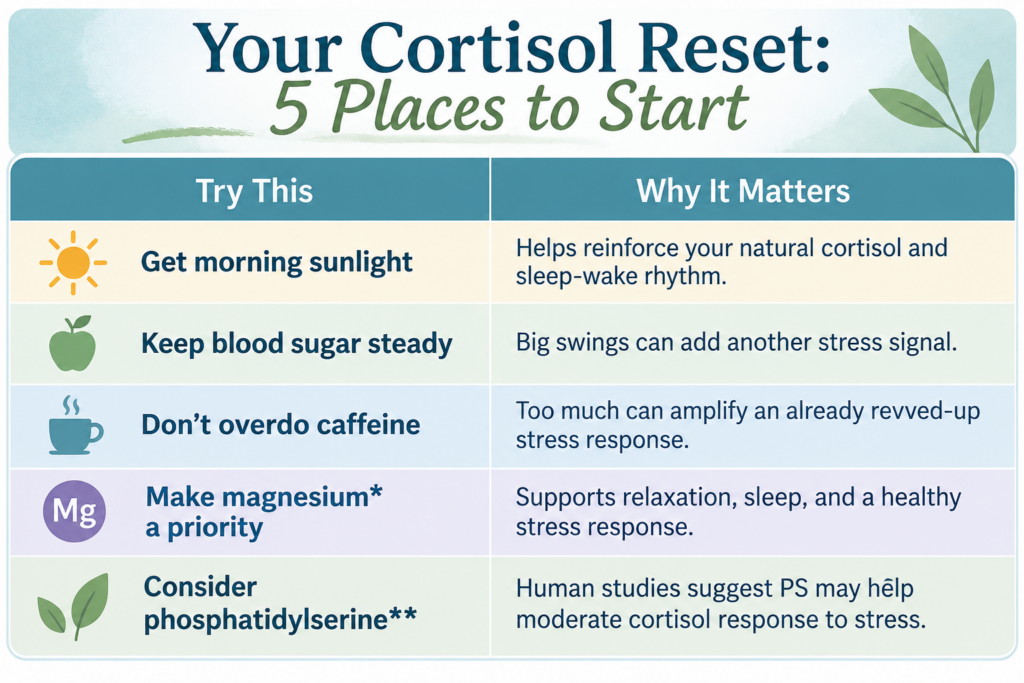
So when I talk about a “cortisol detox,” I mean helping your body step out of that constant state of high alert and return to a healthier stress rhythm.
*My Magnesium Pick: Mag-Key is the only magnesium I recommend. It combines four highly absorbable forms of magnesium, glycinate, malate, taurinate, and orotate, along with activated vitamin B6 to help your body absorb and utilize the magnesium more effectively. I recommend 5 mg per pound of body weight daily.
**My Phosphatidylserine Pick: I typically recommend 600 mg of phosphatidylserine daily for stress support. One option I like is Protocol for Life Balance’s Phosphatidyl Serine, available through my Fullscript dispensary. Each softgel provides 300 mg of phosphatidylserine, so two provide the 600 mg daily amount I recommend.
Frequently Asked Questions
How do you detox cortisol from your body?
You don’t actually “detox” cortisol—it’s an essential hormone your body needs. A cortisol detox is better thought of as supporting a healthier stress response through sleep, blood sugar balance, movement, stress management, and nutrients that support the body’s normal response to stress.
What lowers cortisol naturally?
Regular sleep, morning light, moderate exercise, balanced meals, limiting excess caffeine, and relaxation practices can all help support a healthy cortisol rhythm. Nutrients such as magnesium and phosphatidylserine have also been studied for their roles in the stress response.
Does phosphatidylserine lower cortisol?
Some small human studies suggest phosphatidylserine may help moderate the cortisol response to acute stress. In one placebo-controlled study, 600 mg daily for 10 days was associated with a 39% lower peak cortisol response following exercise.
The Bottom Line
Your body was beautifully designed to handle stress. It just wasn’t designed to live there.
The goal isn’t a life without cortisol—or even a life without stress. It’s helping your body recognize when the danger has passed so it can finally come off high alert.
That’s where the basics matter: good sleep, steady blood sugar, morning light, movement, and the right nutritional support. And based on the research we’ve just looked at, phosphatidylserine may deserve a place in that conversation, too.
Because at some point, the tiger has to leave.
Related:
Why Magnesium Really is A Miracle Mineral
Anxiety — When Your Nervous System Is Running on Fumes
Resources include:
Starks MA, Starks SL, Kingsley M, Purpura M, Jäger R. The effects of phosphatidylserine on endocrine response to moderate intensity exercise. J Int Soc Sports Nutr. 2008 Jul 28;5:11. doi: 10.1186/1550-2783-5-11. PMID: 18662395; PMCID: PMC2503954.
Hellhammer J, Fries E, Buss C, Engert V, Tuch A, Rutenberg D, Hellhammer D. Effects of soy lecithin phosphatidic acid and phosphatidylserine complex (PAS) on the endocrine and psychological responses to mental stress. Stress. 2004 Jun;7(2):119-26. doi: 10.1080/10253890410001728379. PMID: 15512856.
Hellhammer J, Vogt D, Franz N, Freitas U, Rutenberg D. A soy-based phosphatidylserine/ phosphatidic acid complex (PAS) normalizes the stress reactivity of hypothalamus-pituitary-adrenal-axis in chronically stressed male subjects: a randomized, placebo-controlled study. Lipids Health Dis. 2014 Jul 31;13:121. doi: 10.1186/1476-511X-13-121. PMID: 25081826; PMCID: PMC4237891.